Eino "Redd" Ota Applied ML Architecture Research.

Luminous Research ML

Discovery Paroxysm.

An idea can start as a joke. It still has to survive a fair test. We build new ML architectures and run controls that could plausibly win. cDFM is the current main line: conditioned state evolution through learned field operators. The iterations, interrupted runs, corrected baselines, and negative results stay in the record.

01Current line

State evolution through learned field operators.

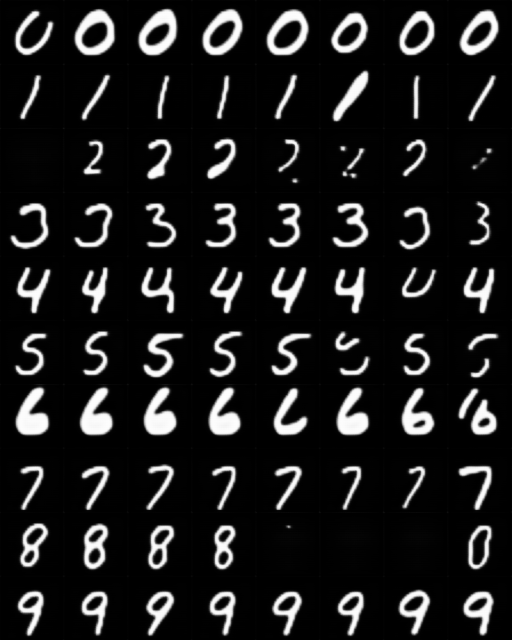
cDFM treats generation as conditioned state evolution. A learned field passes through a wave stage. An aperture shapes it. Diffraction evolves it. Projection turns the resulting state into output. The displayed run is the Stage A promoted multiscale anchor.

Project

cDFM

Active

06 July 2026A Sequential 4-16-64
Final checkpoint samples from the cDFM sequential 4-16-64 Stage A run
Final checkpoint at step 3000. Eight samples per class, ordered from 0 through 9. Frozen-classifier accuracy on this displayed grid: 86.3%.

Stage A promoted anchor

Scale topology was the tested axis. WAD, sharing, fusion, aperture, and the objective stayed fixed across the Stage A comparison.

TopologySequential 4 → 16 → 64
OperatorWAD with learned spectral diffraction
SharingIndependent per scale
FusionGated residual
ApertureConditioned convolutional aperture
ObjectiveMNIST 64x64 image corruption, sigma 0.12, x0 prediction

86.3%Displayed-grid accuracy

0.023228Best validation x0 MSE

558,050Parameters

3,000Optimizer steps

192,000Images seen

10 of 10Class rows alive

03Past line

Compressed retrieval beside local attention.

Atom Attention tested value-level atom slots beside local attention and exact-support cache paths. Pointer-backed v5-P became the strongest Atom variant under the monitoring protocol. The no-atom local+cache control made the mechanism result clear. The atoms added nothing. The line is closed. Its ablation record remains useful.

Project

Atom Attention

ClosedNegative result

Monitoring fragment

Best validation. Lower is better. Mechanism attribution also depends on the no-atom controls.

VariantBest valRead
GPT full1.2286Full attention reference
v5-P and v5c1.3518Pointer-backed atom variant
v5-P+1.3659Stacked feature variant
No-atom local+cache1.4068Local and cache control
Linear attention2.2363Efficient attention reference

04Open threads

Specifications waiting for their first fair run.

3PTR

(s, c, p) in {-1, 0, +1}

3-Parameter Ternary Reasoning proposes a small discrete control substrate for selection, commitment, contradiction, and revision. The Qwen sidecar reached experiments in May, but its causality and gradient-flow bugs were not fixed. There is no clean training result.

Prototype stalled

TRR

Targeted Rapid Refresh focuses a short high-learning-rate update on dense semantic reformulations of one narrow knowledge change. The protocol exists. The implementation and first experiment are still ahead.

Protocol

05Specialist model lines

Small models for specific jobs.

L-series

L0 marks the first experiment. L1 is a scaled iteration. L2 and onward are the next version, upgrade, or iteration.

Main

The general model line. The current plan is to combine the strongest collected data without letting one specialty dominate the model's style.

Early plan

Luau

Roblox Luau specialist. The dataset has been scraped. Filtering and synthetic instruction generation come next for an internal L0-Luau-14B.

Data prep

PolyCore

Low-level C, C++, Rust, and assembly work. Clean C and C++ text data exists. Instruction data is the current gap.

Text dataset

Novelty

Conversation intelligence and coherence. The idea exists. Dataset work is still at zero.

Idea

Memex

English and Japanese information-accuracy Q&A. Wikimedia, OpenAlex, and OpenStax collection are the next steps.

Data prep

SagaForger

The storywriting umbrella. Specialist genre datasets feed the line. Tag-based MoE routing remains a later version target.

Planned

06Research chronology

What was built. What changed. What stopped.

December 2025

Luau releases

L0-Luau-1B and L0-Luau-4B were released.

January 2026

3PTR emerges

The 3-Parameter Ternary Reasoning idea emerged.

February 2026

PolyCore release

L0-PolyCore-4B was released.

March 2026

Atom Attention begins

Work started on value-level atom slots beside local attention and cache paths.

May 2026

Atom Attention closes

The no-atom local+cache control showed that the atoms added nothing. The line was closed and its ablation record kept.

May 2026

3PTR reaches experiments

The Qwen sidecar was tested, but its causality and gradient-flow bugs were not fixed. The experiments did not produce a clean result.

May 2026

cDFM begins

The first WAD experiments used learned wave, aperture, and diffraction operators on MNIST.

July 2026

Staged architecture search

The cDFM runpack now executes full curated rows with mandatory controls and artifact preservation. Stage D is in progress. TRR remains at protocol stage.

07About

Eino "Redd" Ota and collaborators.

LRML is run by Eino "Redd" Ota. J. "Brilliance" O. and "Quedol" contribute.

EO

Eino "Redd" Ota

Architecture research

JO

J. "Brilliance" O.

Contributor

Q

"Quedol"

Contributor